2026年10月
健康・検査のことGot Your Health Checkup Results in Japanese? A Lab Technician Explains What They Mean
 書いた人:臨床検査技師30年・超音波検査士プロフィール
Your health checkup results arrived. But everything is written in Japanese. You don't know where to look.
I wrote this article for you.
After reading it, you will know which parts of your results to check.
I am a clinical laboratory technician. I have worked in medical testing in Japan for many years. Every day, I perform tests for many people.
First, Check These Two Things
Your results sheet has many numbers and letters. But you do not need to understand all of them at once.
First, check these two things:
- The overall result (総合判定, sougou hantei)
- The instructions for each test item (判定・事後指導, hantei / jigo shidou)
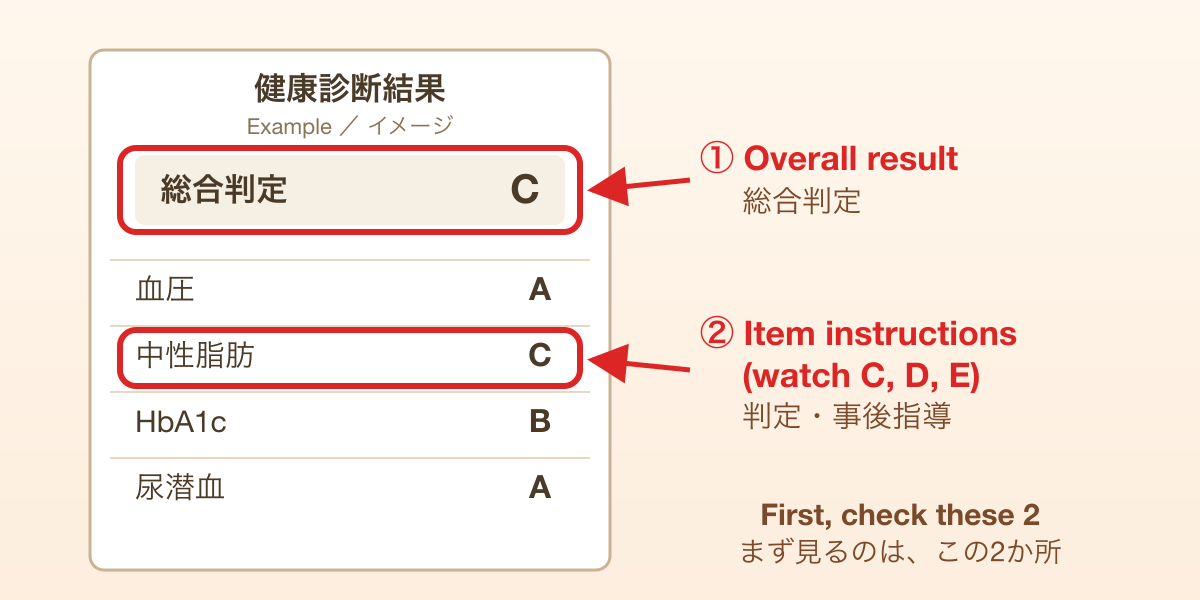
The overall result is a summary of all your results. It is often on the first page, or at the top.
Next, pay special attention to items marked C, D, or E. However, the meaning of each grade can differ between facilities. Always read the comments and instructions written on your own results sheet.
A or B generally means that no urgent action is indicated by that result. However, if you have symptoms or are already receiving treatment, please follow your doctor's advice.
What the A–E Grades Mean
In Japanese health checkups, results are often shown with letters. The table below is an example, based on the grading system of the Japan Society of Ningen Dock and Preventive Medical Care (revised April 2026).
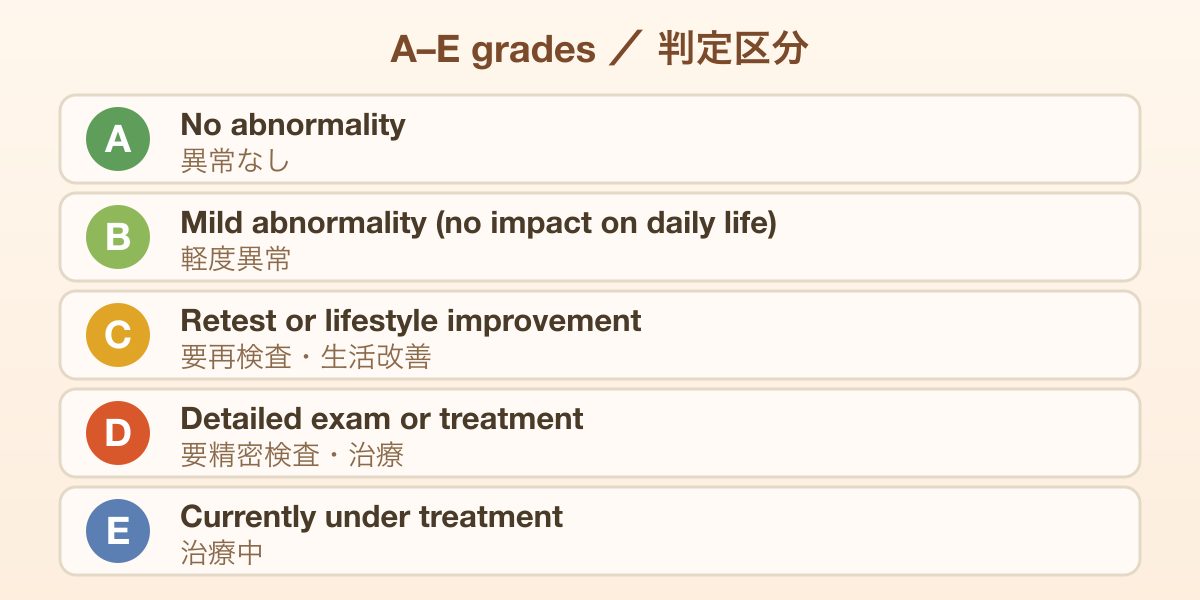
| Grade | Japanese | Meaning |
|---|---|---|
| A | 異常なし | No abnormality |
| B | 軽度異常 | Mild abnormality (no impact on daily life) |
| C | 要再検査・生活改善 | Retest or lifestyle improvement needed |
| D | 要精密検査・治療 | Detailed examination or treatment needed |
| E | 治療中 | Currently under treatment |
Some facilities divide D into two grades. For example, D1 means "medical care needed," and D2 means "detailed examination needed."
Note: "Retest" (再検査, saikensa) means checking the same numbers again. "Detailed examination" (精密検査, seimitsu kensa) means doing additional tests to find the cause.
Important: Not all health checkup facilities in Japan use exactly the same grading system. Your facility may use different letters, numbers, or explanations. Please follow the instructions on your own results sheet rather than relying on this table alone. If you are unsure, please ask the facility where you had your checkup.
If you are already being treated (E), please show your checkup results to your doctor.
What "H" and "L" Mean Next to the Numbers
You may see "H" or "L" next to a number.
- H … higher than the reference range (High)
- L … lower than the reference range (Low)
The reference range differs slightly between facilities.
An H or L does not always mean you are sick. Even healthy people can be slightly outside the reference range. Please do not judge by H or L alone. Look at it together with the grade (A–E).
Common Japanese Test Names on Your Results
Here is a table of test names you will often see on your results. Please compare it with your own results sheet.
| Japanese | Reading | English |
|---|---|---|
| BMI | ― | Body mass index |
| 血圧 | ketsuatsu | Blood pressure |
| 腹囲 | fukui | Waist circumference |
| 空腹時血糖 | kuufukuji kettou | Fasting blood glucose |
| HbA1c | ― | HbA1c |
| 中性脂肪 | chuusei shibou | Triglycerides |
| HDLコレステロール | ― | HDL cholesterol |
| LDLコレステロール | ― | LDL cholesterol |
| AST(GOT) | ― | AST |
| ALT(GPT) | ― | ALT |
| γ-GTP | ― | Gamma-glutamyl transferase (γ-GT) |
| クレアチニン | ― | Creatinine |
| eGFR | ― | Estimated glomerular filtration rate |
| 尿酸 | nyousan | Uric acid |
| 赤血球 | sekkekkyuu | Red blood cells |
| 血色素(ヘモグロビン) | kesshikiso | Hemoglobin |
| 白血球 | hakkekkyuu | White blood cells |
| 尿蛋白 | nyou tanpaku | Urine protein |
| 尿糖 | nyoutou | Urine glucose |
| 尿潜血 | nyou senketsu | Urine occult blood |
| 尿比重 | nyou hijuu | Urine specific gravity |
| 心電図 | shindenzu | Electrocardiogram (ECG) |
| 眼底検査 | gantei kensa | Fundus examination |
| 胸部X線 | kyoubu ekkusu-sen | Chest X-ray |
Where People Often Get Stuck
When I explain a test, I often use gestures. For tests where you only lie still, like an electrocardiogram (ECG), gestures are usually enough.
The challenging part is when I need you to follow my instructions during a test. For an abdominal ultrasound, I ask you to puff out your belly and hold your breath. I use simple words like "breathe in" and "breathe out." But the finer details are hard to get across.
For a lung function test (spirometry), I ask you to breathe in as deeply as you can, and then blow out all at once. We do this test together, so I show you how to do it myself. My face is very serious when I do. In fact, for lung function tests, it is considered important for the technician to show you how, and to encourage you, to get accurate results.
I have also tried translation apps, and showed written spellings of names. But in the end, gestures work best. In other words, my serious demonstration.
If I say the name of the test in English, a short explanation is usually enough.
Before a test, I may ask about your symptoms. Chest pain, stomach pain, headache. And where exactly it hurts. This is actually an important clue for the person doing the test. But medical English is often not the first language for either of us. It does not get across as well as we hope.
To be honest, I rarely have trouble explaining things to you. The opposite is harder. When you describe your symptoms in English, sometimes I do not understand, and I can see you are disappointed.
If you cannot find the words, please point to where it hurts and say "here." That alone helps a lot.
At the reception desk and before a test, I will ask for your name and date of birth. I may also ask how to spell your name. Sometimes a name is too long to fit in the machine. Sometimes I do not know where to divide it. Sometimes I call your name out loud, but you do not recognize it. We are both trying our best, but we do not quite connect. I have seen moments like this many times.
Shoes can also be confusing. In Japan, you take off your shoes before getting on the examination bed. "I have to take off my shoes to lie on a bed?" I have been asked this many times.
Clothing matters too. Long clothes, or one-piece clothes, are hard to take off and put on during tests. On the day of your checkup, please wear a two-piece outfit (a top and bottom) that is easy to put on and take off. It helps the tests go smoothly.
That is why I hope you can at least read your results sheet calmly. I wrote this article with that feeling.
What to Do If You Are Told to See a Doctor
If your results sheet says you need a retest, a detailed examination, or treatment, please visit a medical institution. Bring these with you:
- Your checkup results sheet
- A referral letter (紹介状, shoukaijou), if one came with your results
For high blood pressure, blood sugar, or cholesterol, you can often start with Internal Medicine (内科, naika). However, if your results sheet includes a referral letter or recommends a specific department, please follow those instructions.
On the other hand, you do not need to do these things:
- Rush to a doctor because of a B grade. A B grade does not mean you need to see a doctor right away.
- Search the internet for every single item. Too much searching can make you more worried.
You can find medical institutions that support foreign languages here:
- JNTO "Guide for when you are feeling ill" (Japan National Tourism Organization) You can search for medical institutions by area, department, and language. Available languages may change, so please check with the institution before you go. (JNTO website)
- Medical Information Net "Navii" (Ministry of Health, Labour and Welfare) You can search medical institutions all over Japan by language and department. The site can be switched to English. (Navii website)
- Japan Visitor Hotline (JNTO): 050-3816-2787 Open 24 hours a day, every day. English, Chinese, and Korean are available. It is mainly for people visiting Japan as travelers.
- AMDA International Medical Information Center: 03-6233-9266 Medical consultation in many languages for foreign residents in Japan. It is open on weekdays during the day, and the available languages differ by day of the week. (AMDA website)
Your city, town, or prefecture may also have a consultation desk for foreign residents.
Opening hours and languages may change. Please check the official websites before calling.
If you had your checkup through your company, you can also talk to the person in charge of health management at work.
Finally, one important thing. Please always talk to a doctor before making any decision about your results.
Summary
On your results sheet, first check these two things:
- The overall result
- The instructions for each item, especially those marked C, D, or E
If you are worried about your results, please talk to the facility where you had your checkup, or to a doctor.
Before your checkup, you may also receive stool and urine sample containers. See Stool and Urine Samples in Japan: A Lab Technician's Step-by-Step Guide.
This article is based on my experience as a clinical laboratory technician and general knowledge. Grading standards differ between facilities. For diagnosis and treatment, please always consult a medical institution.
おひとりさま検査技師
臨床検査技師として病院に30年。生理検査全般を担当、とくに超音波検査(おもに心エコー)。地方在住・50代・おひとりさま。 検査室から見えることと、暮らしのことを書いています。詳しいプロフィール